The overdriven sound of a valve power amplifier is highly desirable, with many different output stage designs to produce the variety of trademark sounds heard on modern recordings. The only problem is that a valve power amplifier is only capable of producing this sound at one volume (usually, fairly loud!). Dummy speaker loads (the good ones are not just resistive, they need to simulate the reactive load of a speaker) allow a player to use one amplifier in a variety of playing situations and styles by running the amplifier at the desired level, and using the dummy load to regulate the volume level. Another option for the playing musician is to use a variety of amplifiers, however, this approach appeals only to rare wealthy musicians. There are probably 3 distictly identifiable types of valve power amplifiers used:
Boutique amplifier builders offer composite designs, offering characteristics of all designs. This can be done dynamically (by responding to picking strength and volume settings), or with various switching schemes. Mesa Boogie has built it excellent reputation for tube preamp overdrive and tone shaping designs, used in conjunction with high quality tube power amplifiers. For most of us, we can use a wide range of effective stomp boxes for our overdive and distortion sounds. |
|
There is much history on the attempts to recreate the desirable overdrive sounds with
various non-linear preamplifier designs. When a player tests one of these devices,
the first impression is usually formed on the type of overdrive character and tone
produced, and players will be looking for sufficient flexibility in the controls to tailor
this to their personal tastes. The basic types of overdrive are generally
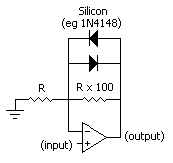
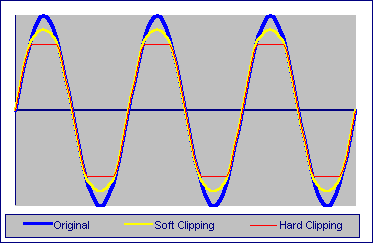
classified as soft and hard clipping. Soft Clipping: This is usually marketed as "overdrive", where the gain is inversely proportional to the input signal level. This is typically produced either with back to back silicon signal diodes in the negative feedback path of an op-amp, or with germanium diodes or LEDs back to back in a shunt to ground. |

| Hard Clipping: Usually marketed as "distortion",
where the signal level is restricted within a range. This is typically produced
with silicon diodes back to back in a shunt to ground. This is the same as the
circuit above, using silicon instead of germanium/LED diodes. Here's a picture of what soft and hard clipping do to your guitar signal: |
| There are some other criteria which players will notice (but maybe not immediately)
when using these circuits: The ability to retain timbre. Different guitar pickup combinations produce recognisable signature sounds of the instrument used. By its nature, overdrive will mask this timbre to some extent, however, many musical styles prefer to retain as much of the original character as possible. Inter-modulation distortion. Again, by its nature, overdrive will produce inter-modulation distortion when two or more notes are played together. For just two notes played, inter-modulation distortion produces an additional note with a frequency of the difference between the original two notes. For chords, where up to 6 notes are played, the combinations of note pairs can produce an unrecognisable mess of distortion. On the other hand, this is actually desirable in musical styles which use mainly power chords, because in this case, the inter-modulation distortion adds a note which is tune with the chord. For other styles, where a player may want to hold one note and bend (change the pitch of) another, a slurring bass note occurs which is generally quite undesirable. This can be minimised to some extent by limiting bass response. Sustain vs Dynamics. One of the key desirable features of overdrive is the sustain produced, however, too much sustain will destroy the dynamics. Players will also want to use the overdrive sound for single note solo work, and be able to turn down their guitar volume (effectively reducing the gain of the overdrive preamplifier) to clean up the sound for chord work. Some designs are better than others in this ability to compromise sustain and dynamics. Designs that give the impression of 'switching' from overdrive to clean as a note fades are usually perceived as sounding unnatural. Frequency compensation. Because preamplifiers are generally connected between the guitar and the amplifier tone circuit, there is no pickup equalisation to compensate for reduced treble response. Consequently, it is usual to limit the bass response before the overdrive section. While it would be logical to boost it after the circuit, this makes the inter-modulation distortion more noticeable, so this is rarely done. The overdrive circuit itself adds higher frequency components to the sound simply because the overdrive circuit is non-linear. These must be cut to preserve some tone similarity with the unprocessed sound, and to also remove unwanted high frequency components. Most players prefer this to be adjustable, to suit their own tastes. |
|
Facts and opinions In writing these pages, I have tried hard
to avoid giving my opinions; instead I've tried to give you just the facts so you can draw
your own conclusions. I'll let you decide how successful I've been. In
talking about some classic overdrive pedals, though, I think I can add some value by
giving you my impressions of how these pedals sound to me. I've also shown portions
of the schematics of these pedals to explain their unique fetaures. These
schematics are not complete; they show only the effect signal path, and not all component
values are shown. Please don't email me asking for these values, because I don't
know what they are. Of course, if you do know, and want to tell me ... MXR Distortion + Although labelled as distortion, this is a soft clipping device, using germanium diodes. It's a good example of how little you need for a good basic sound. You could easily swap (or switch) these diodes to silicon types for hard clipping. |

| ProCo Rat Distortion Not necessarily the next pedal chronologically, but look at how similar this design is. It uses 2 silicon diodes for symmetrical hard clipping. I would also expect that at high gain settings, the IC also clips to the supply rails. |

| Ibanez Tube Screamer No discussion on overdrive pedals is complete without looking at the Ibanez Tube Screamer. There have been several minor variations of the pedal released by Ibanez, and a larger number of variations sold by boutique pedal manufacturers. As our guitar heroes die, it seems the equipment they used somtimes takes on a mythical status. In my opinion, this is the case with the genuinely legendary Stevie Ray Vaughn and the Tube Screamer. This results in some silly prices for original pedals, and a lively market to convert different pedals to Stevie's model. Nevertheless, the green Ibanez box is a very smooth sounding pedal that retains the guitar timbre well, and for that reason works well with single coil guitars. There is not an enormous amount of drive available, and the tone control is subtle. Like many overdrive pedals, there is some middle boost, caused by the bass cut before overdrive, and treble cut afterwards. Another common use for these pedals is as a middle booster to drive a valve amplifier harder. This is done by setting little or no drive, but with the level set high. In the schematic, you can see two silicon diodes, back to back, in the negative feedback path of an op-amp. This arrangement gives symmetrical soft-clipping. |
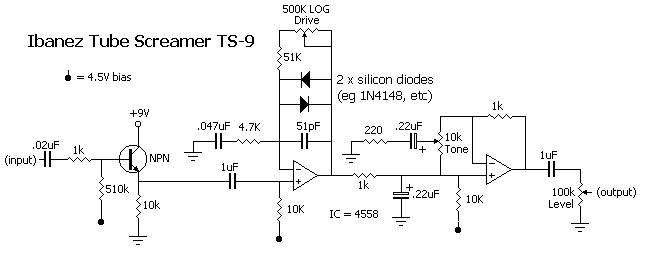
| Boss Super Overdrive SD-1 These were originally sold without the tone control. The design is nearly identical to the Ibanez Tube Screamer with 2 important changes. More boost is available, but is partly offset by using 2 diodes in one direction and only one in the other. This produces asymmetrical soft clipping, meaning that one side of the waveform is clipped more severely than the other. A more common implementation of assymetrical clipping is to use 2 silicon diodes, with a germanium diode in series with one of them. There is lively debate on the Internet about whether this sounds more natural, and whether it better emulates some asymmetric valve phase splitter designs. In any case, I think it does add a little character, and therefore suits humbucker guitars well. |

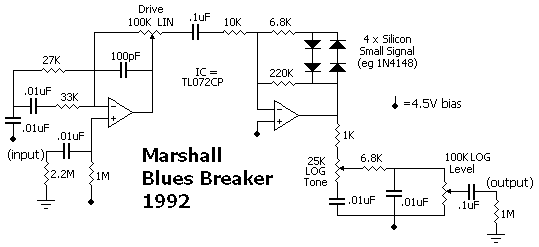
| Marshall Pedals: Blues Breaker, Drive Master & Shred Master These three pedals were released in the early 90's, and use different clipping and tone shaping techniques to deliver different sounds. The Blues Breaker uses silicon diodes in series with a resistor, in the op-amp feedback path for very soft clipping. It's therefore a very subtle pedal, with warm sounds at low to medium overdrive, but can sound a little fuzzy at high gain. Retention of guitar timbre and dynamics is good, and intermodulation (read above) is acceptable. |
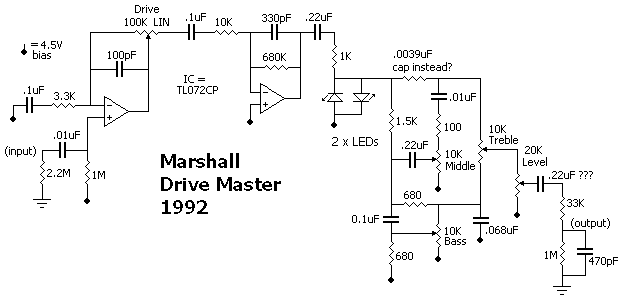
| The Drive Master uses LEDs shunting to ground for symmetrical soft clipping. I like this pedal for its howling Marshall stack-like qualities with single note solos and power chords. Dynamics are good at high drive levels, retention of timbre is excellent, but intermodulation is a problem for anything but simple chord work. |
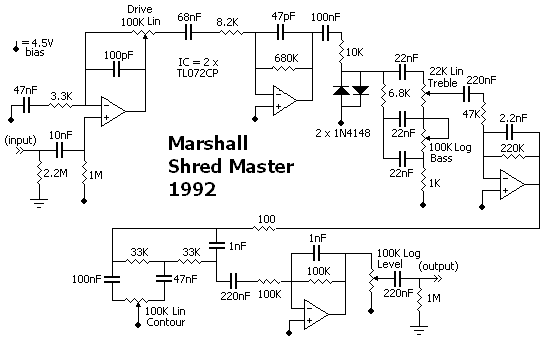
| The Shred Master is not quite the animal its name implies. It uses silicon diodes shunting the signal to ground, for symmetrical hard clipping. Bass and treble controls, and a contour control offering middle boost and cut sounds give a wide range of usable sounds, although I'm not convinced shred is one of them. Retention of dynamics is good, intermodulation is OK, and retention of timbre is good at low drive settings. |
|
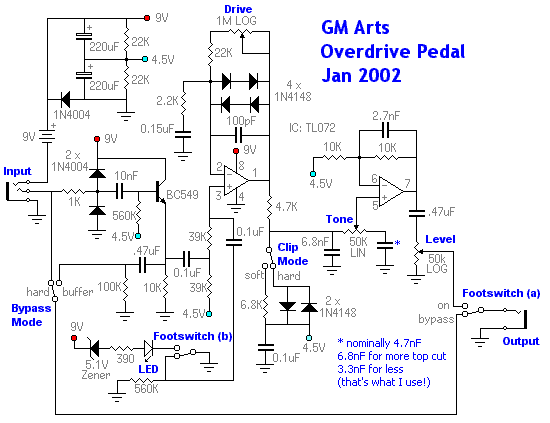
Here is a circuit that combines many desirable features. Feel free to
experiment with the component values. For example, using lower value capacitors
around the tone control will give a brighter sound, and vice versa. The capacitor
on the left sets the tone at fully clockwise, while the one on the right sets the minimum
tone sound. This circuit has been updated for 2002. A buffer mode switch has been added - see the notes below (normally you would just wire this permanently the way you want to use it. The circuit features are:
|
|
The Op Amp should be any dual low noise device, such as a TL072. The 1N4148
diodes can be any small signal silicon diodes. The 1N4004 diodes can be any 1 amp
rectifier diodes (eg 1N4007 is OK also). The input buffer transistor should be any
high gain low noise device, such as a BC549. The top left portion of this circuit supplies 9V power and 4.5V bias to the rest of the circuit. Connect all the 9V points together, and connect all the 4.5V points together. |